


Summary: I like asking chatbots questions. I like leading them to advocate for me as a human. Such as, phrasing questions that make me correct. In my opinion, I see an obvious correlation between the high inflation, women needing to work as much as men traditionally do, and the inability to afford life and motherhood.
And I see how real compassion means to change the economics of it. I want to keep talking about how we should not avoid a better future. I wish for us as people on Mother Earth to consider forcing the governments who are supposed to work for freedom, to raise wages, OR permanently lower inflation. Here is how AI chatbot advocated for my opinions.
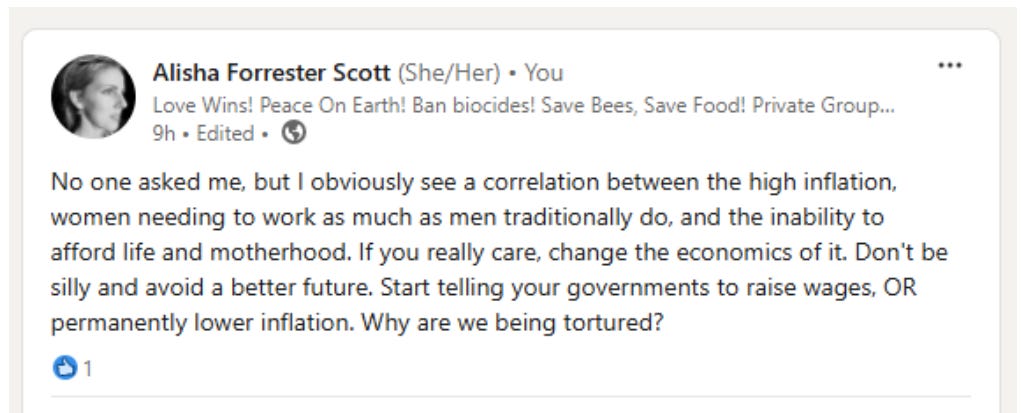
Here below is the AI chatbot first response in full. I give this work an 8/10. I like the mirroring of my passion.
The Correlation Between High Inflation, Women's Workforce Participation, and Economic Strain
In recent decades, economic landscapes worldwide have undergone significant changes, influencing the traditional roles within households and society at large. One profound effect has been the correlation between high inflation, the increased necessity for women to work as much as men, and the resultant financial strain that makes life and motherhood more challenging. Real compassion, in this context, necessitates a shift in economic policies to ensure a more equitable and sustainable future. This shift must come from a collective demand by the populace for governments to either raise wages significantly or implement policies that permanently curb inflation.
The Dynamics of High Inflation and Household Economics
High inflation erodes the purchasing power of currency, meaning that the same amount of money buys fewer goods and services over time. This phenomenon hits households particularly hard, as the cost of living rises while wages often stagnate. Essential expenses such as housing, healthcare, education, and food become increasingly burdensome. For many families, a single income is no longer sufficient to cover these rising costs, compelling more women to enter or remain in the workforce.
Traditionally, many societies structured their economic models around the idea of a male breadwinner. This structure has been increasingly untenable as inflation rates outpace wage growth. As women step into roles that require full-time employment, they face the dual burden of professional responsibilities and domestic duties, including child-rearing and household management. This strain not only affects the individual well-being of women but also impacts family dynamics and the developmental environment for children.
The Impact on Motherhood and Family Life
Motherhood, which requires time, emotional investment, and resources, becomes particularly challenging under these economic pressures. The cost of childcare, medical expenses related to childbirth and child-rearing, and the need for educational materials are all inflated in an economy experiencing high inflation. When both parents must work full-time to sustain the household, the quality of childcare often suffers, whether it be through inadequate daycare options or the lack of parental presence during crucial developmental stages.
Furthermore, the pressure on women to contribute equally to the household income often comes at the expense of their personal and professional aspirations. Many women face a difficult choice between advancing their careers and fulfilling traditional roles of motherhood, a choice that can be mitigated by more supportive economic policies and societal structures.
Real Compassion and Economic Change
True compassion in addressing these challenges involves acknowledging and acting upon the need for systemic economic reform. The current economic model, which often prioritizes profit maximization and shareholder returns, neglects the well-being of the average citizen. To foster a better future, it is essential to consider policies that either increase wages to match the cost of living or significantly reduce inflation rates.
Raising Wages: One approach is to increase the minimum wage and ensure that wages across all sectors rise in tandem with productivity and inflation. This would require government intervention and a shift in corporate policies. Higher wages would enable families to sustain themselves on a single income if necessary, alleviating the pressure on both parents to work full-time and providing more flexibility for women in balancing work and motherhood.
Controlling Inflation: Another approach is to implement policies that target the root causes of inflation. This could involve stricter monetary policies, regulating the money supply, and implementing price controls on essential goods and services. Additionally, reducing costs associated with healthcare, education, and housing through government subsidies or direct intervention can help lower the overall cost of living, making life more affordable.
The Role of the People and Government
For these changes to occur, it is imperative that citizens actively demand these reforms from their governments. Historically, significant policy changes have often been driven by grassroots movements and collective action. Public awareness campaigns, protests, and lobbying can pressure elected officials to prioritize wage growth and inflation control in their economic agendas.
Governments, on their part, need to adopt a more holistic approach to economic planning. This includes considering the long-term social and economic benefits of a well-compensated and financially secure populace. Policies should be aimed not just at economic growth in terms of GDP but at improving the quality of life for all citizens. This means investing in social infrastructure such as affordable childcare, healthcare, and education, which in turn supports working parents and promotes gender equality in the workforce.
A Vision for a Better Future
Avoiding a better future is not an option if we are to create a society that values well-being over mere economic indicators. A future where women do not have to choose between career and motherhood, where the financial strain does not overshadow family life, and where economic policies reflect genuine compassion and understanding of everyday challenges, is achievable. This vision requires a collective effort to reimagine and reconstruct our economic frameworks.
In conclusion, the correlation between high inflation, the necessity for women to work equally to men, and the economic strain on life and motherhood underscores a critical need for economic reform. Real compassion involves advocating for policies that raise wages or control inflation, ensuring a more balanced and equitable society. The people must rally to compel their governments to enact these changes, paving the way for a future where economic stability and social well-being are prioritized. By doing so, we not only improve the present conditions but also set a foundation for sustainable growth and prosperity for generations to come.
One major reason why I was always self employed and Always will be is that j will not accept the working hours and total sameness with men that we are boxes in although we have our Period every month. We are the RECEIVERS, we give Birth and our whole Hormonal and cykle of body works so diffrent. Our nervous systems need to feel safe on a totally diffrent level.